Weekly Links: Some Tweaks and the 2025 Whirlwind
2025 was a wild ride in AI. In this post we recap the year and there are some updates on the newsletter going forward.
It's been a crazy year in AI, and it's fun writing this newsletter to marvel at the things happening every week. There has been quite a bit of AI news this week, despite the holiday (including another huge possible New Year's surprise from Deepseek), but I will keep all those in the hopper for next week.
Instead, I thought I'd take a moment to take a breath and pick out some of the craziest stories from 2025, plus trail a couple of small tweaks I'm thinking about for the newsletter:
- The first tweak I've implemented already: that is, dropping the "sending day" from the title... (Friday Links, Saturday Links, etc.). The format made sense to me at the beginning since it was a good forcing function to get the newsletter published early (I really wanted zero "Monday Links"!). On the whole, though, it's probably quite confusing, so I've decided to shift to "Weekly Links". I do still plan to get them out on the same schedule, though: Fridays, Saturdays, or Sundays, with a preference for earlier!
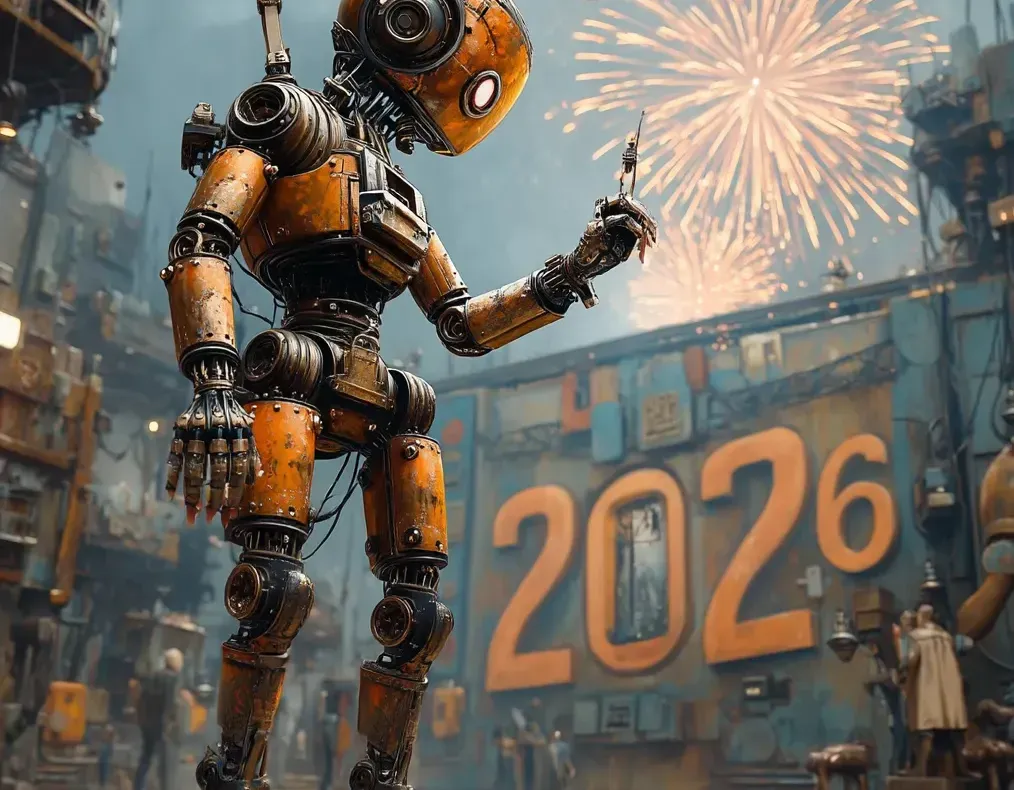
- I've been playing with some evolutions of the artwork as well. I love the steampunk Robots that appear now and want to retain the aesthetic, but Midjourney just isn't that controllable, so I'm on the hunt for some other tools (or just new workflows)!
- I keep resolving to write some longer posts, and that's finally working. Look out for something in the next week or tw,o I hope!
In the meantime, thank you all for the support. It's been fun to write the posts and even better to get feedback from you all. Sounds like some of them even get read! Looking forward to another wild AI year in 2026.
Of the 2025 news, here are a few that really stood out for me as big indicators of change (hard to believe all this happened in a single year):
January
- Google is making AI in Gmail and Docs free — but raising the price of Workspace. Google, Microsoft, and others decided the best strategy for AI distribution was to bundle it ... and raise prices. A year on, it's not clear this is working particularly well. Adoption is patchy, it seems. On the other hand, people seem to have forgotten about the price rises.
- A Waymo robotaxi and a Serve delivery robot collided in Los Angeles. This just seemed the perfect story to illustrate the strange world we will all soon be living in.
February
- From Prompt to Product: The Rise of AI-Powered Web App Builders. Early in the year, we saw the first inklings that AI-prompted app and web builders would be big. Since then, Lovable, Replit, Bolt, new, and other players like Base44/Wiz have become huge players.
- U.S. Copyright Office says AI-generated content can be copyrighted — if a human contributes to or edits it. Copyright is never a fun topic, but this might end up being a key ruling. The fact that AI-generated content can be copyrighted in the United States means creative industries will almost have no choice but to lean in and begin using it.
March
- MCP: The Ultimate API Consumer (Not the API Killer). MCP starts to become much more widely adopted for LLM tool usage. This has continued to accelerate through 2025.
- The AI-Generated Studio Ghibli Trend, Explained. OpenAI added a new form of image generation (Autoregressive) into ChatGPT, and usage exploded through the generation of Studio Ghibli-style images. The trend quietened down, but the functionality was a true game-changer, making AI images much more controllable. Arguably, Google's Nanobanana now has the lead in this regard, but the capabilities from multiple companies are now very impressive.
April
- AI 2027. We got the AI 2027 Report, which suggested Humanity might be on the path to extinction in the next 10-15 years. I think the signs are not as strong, though, but it's still useful to contemplate these negative scenarios.
- OpenAI and Shopify poised for partnership as ChatGPT adds in-chat shopping. The first sign that OpenAI would go hard after e-commerce.
- OpenAI undoes its glaze-heavy ChatGPT update. OpenAI turned AI sycophancy up to 11, and it turns out humans didn't want to be quite that flattered.
May
- Everything We Know About OpenAI’s $6.5 Billion Purchase Of Jony Ive’s Io. First warning that we're likely going to see OpenAI hardware. It also signalled the start of a wave of big business bets from OpenAI.
- Google unveils ‘AI Mode’ in the next phase of its journey to change search. Google starts to respond to ChatGPT's primary threat - on search. Now, AI mode pops up in queries to provide answers rather than links. This (like ChatGPT) still has reliability issues - for example, take care with health advice. That's inherently more risky for Google than it is for OpenAI.
- Introducing Codex. OpenAI introduced the Codex coding agent to rival Anthropic's Claude Code. At the time, software developers were skeptical that a long-running process with "access to everything" really made sense. That skepticism persists for many people, but adoption has been rapid, and productivity gains can be truly impressive (they are at Safe Intelligence). It's impressive to remember that Agentic coding is really less than 12 months old (there were earlier attempts, but it became mainstream with this release).
June
- Mosquito-sized drone is designed for Chinese spy missions — military robotics lab reveals incredibly tiny bionic flying robots. Mosquito-sized military drones. Yikes.
- Yep, GoPro Should Be Really Worried About Meta’s New ‘Performance’ Smart Glasses. Smart glasses do seem to be significantly on the rise. This might be a key sleeper category for Meta (and others). I bought the Gen 1 Ray-Ban Meta Smart Glasses and still love them.
- ChatGPT is back following global outage — here's what happened. ChatGPT had a global outage, and the world panicked...
July
- Pay up or stop scraping: Cloudflare program charges bots for each crawl. Cloudflare begins blocking AI bots by default... this story has gone a little quiet, but I still think there is a huge shift to be worked through on how the open web evolves (or dies...) due to AI.
- Nvidia Hits $4 Trillion Valuation Milestone on AI Demand. In late October, it closed above $5T. Down a bit since. For comparison, Apple was the first company to cross $1T just 7 years ago in 2018 (now also at $4T).
- Exclusive: OpenAI to release web browser in challenge to Google Chrome. Opening a fight on another front, OpenAI releases a browser. There are also several other AI browsers, though it's still unclear how much adoption they are getting (or how safe they are).
August
- A Survey of Context Engineering for Large Language Models. Context engineering (management of what is in the context window and execution environment of an LLM) has started to become increasingly important.
- Taco Bell rethinks AI drive-through after man orders 18,000 waters. Some AI rollouts go too fast.
September
- Google Gemini dubbed ‘high risk’ for kids and teens in new safety assessment. In an expanding issue that affects OpenAI, Google, and all model providers, human usage can also lead to harm. Children and teenagers can create strong trust bonds in model conversations, and models are ill-equipped to handle sensitive queries.
- Teaching LLMs to Plan: Logical Chain-of-Thought Instruction Tuning for Symbolic Planning. One of several examples of an interesting confluence of non-symbolic and symbolic AI.
October
- Less is More: Recursive Reasoning with Tiny Networks. Promising new tricks stack up to make high-powered reasoning available in smaller models.
- Qualcomm acquires Arduino to supercharge the global maker movement. Qualcomm wants to win the edge.
- Evaluating the Impact of AI on the Labor Market: Current State of Affairs. The estimation and predictions about the AI impact on human labour continue in many forums, but there is really very little that can be said with certainty.
November
- Sam Altman says OpenAI has $20B ARR and about $1.4 trillion in data center commitments. OpenAI and the industry, more generally, ramp up planned infrastructure spending to mind-boggling levels, raising fears (and endless talk of...) an AI Bubble.
- Disrupting the first reported AI-orchestrated cyber espionage campaign. Cyber-espionage using LLMs reaches new levels.
- Nate Soares on the Risky Business podcast. AI doom-leaning scenarios. Good discussions to have and a useful new book to put things into perspective
December
- Ilya Sutskever on the Dwarkesh Podcast. A really thoughtful long range look on where LLM systems in paricular might be headed with some concrete thoughts about safety.
- The Walt Disney Company and OpenAI reach landmark agreement to bring beloved characters from across Disney’s brands to Sora. Something that probably signals the future of creative industries and AI. Brand licensing is here.
2025 had been quite a blast... wishing you an amazing 2026! Perhaps a bit calmer? But no doubt it will be full of surprises as well.
Steve.